The LM&TD Weekly Recap is BIA’s weekly look back at the most important stories from our Local Media & Tech Daily (LM&TD) newsletter.
Kicking Off Forecast 2027 With BIA’s Outlook
BIA Advisory Services and WPP Media opened Forecast 2027 on Thursday at New York’s Harvard Club with an economic outlook for the year ahead. Panelists named the verticals most worth chasing and the strengths broadcasters will need to lean on. Later sessions put recent blockbuster deal valuations under scrutiny, with Randy Michaels moderating “Who’s Buying Broadcast?”, and the “Broadcast on the Docket” panel pressed the case for passing the AM Act.
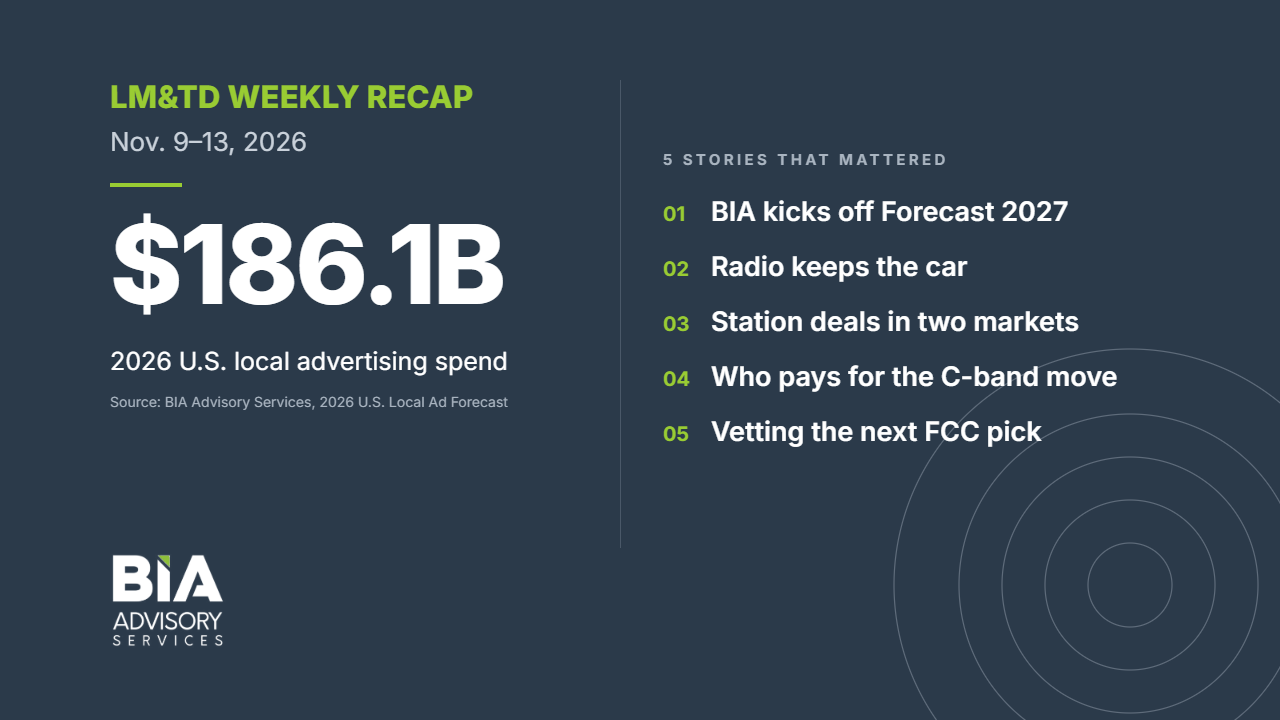
For sellers working out where 2027 dollars will come from, BIA’s Leading Local Insights podcast added the small-business view. BIA’s Celine Matthiessen talked with Mandy Febus, CMO of Valpak Clipp, about its 2027 State of Local Business Advertising survey. Nearly one in four owners said fear of a failed campaign worries them more than lack of time, and about 36% would consider adding TV. Febus’s advice for media sellers: lead with measurement, bring targeting data and pitch spring campaigns well before Q2, which is the heaviest spending quarter for more than a quarter of owners. Those businesses drive much of BIA’s $186.1 billion local advertising forecast.
Owning the Car: New Audio Data From Nielsen and Edison
Nielsen’s Q3 edition of The Record, covered by RBR, found U.S. consumers spent 3 hours and 55 minutes a day with audio from July through September. Radio and podcasts take 83% of ad-supported audio time. Among adults 18+, radio alone holds 62% and podcasts 21%; among adults 18-34 the split narrows to 42% for radio and 33% for podcasts. Radio still reaches 92% of U.S. adults each month, more than 242 million people.
Edison Research’s Share of Ear location data, reported by Radio Ink, shows where each platform wins. AM/FM indexes at 160 in the car and satellite radio at 232, while YouTube indexes at 140 at home. AM/FM accounts for 81% of ad-supported in-car audio time among persons 18+.
For radio, the in-car advantage is the strongest argument for the AM Radio for Every Vehicle Act. The House passed H.R. 979 by voice vote in September, and the Senate companion, S. 315, has more than 60 bipartisan cosponsors but has not yet passed. For TV and digital sellers, the same data shows YouTube outperforming its overall share of listening at home, often on connected TVs.
Buying Radio Stations in Cincinnati and Nashville
Randy Michaels is adding to his Cincinnati-area radio collection. His Radioactive LLC signed a $110,000 agreement with Reign Enterprizes to buy Gospel “1320 The Voice” WCVG-AM and its FM translator, just across the Ohio River from the city. The deal needs FCC approval, and Radio Ink expects the signal to give Michaels’ Oldies WKRP a stronger presence in downtown Cincinnati.
In Nashville, Garth Brooks’ Sevens Network agreed to pay $3 million for the 100.1 frequency now home to Adult Alternative “Lightning 100” WRLT, owned by Lester Turner’s Tuned In Broadcasting. Brooks plans to relaunch it as FM-100, a Country station focused on female artists. The Lightning brand will continue on 106.3 and WPRT-HD3 under Bud Walters’ Cromwell Media. Both deals show owners with a specific local plan still buying stations at modest prices, even as Forecast panelists questioned valuations in the biggest transactions.
Fighting Over Who Pays for the C-Band Move
The Upper C-band debate has moved from how much spectrum the FCC will auction to how much broadcasters will be repaid for moving. Under the FCC’s Upper C-band order, new wireless licensees must reimburse incumbents’ reasonable and necessary transition costs, and the agency’s Wireless Telecommunications Bureau has proposed a preliminary cost catalog to estimate them. In comments filed this week, the NAB told the FCC that the catalog significantly underestimates those costs because it leans on inflation-adjusted figures from the earlier Lower C-band transition. NAB argues this move is different: many stations may need to shift to Ku-band satellite or terrestrial distribution rather than modify existing receivers.
For radio and TV groups that rely on satellite-delivered network and syndicated programming, the final catalog will determine how much of the equipment bill they cover themselves. The FCC has not yet adopted it.
Questioning the Next FCC Commissioner
The Senate Commerce Committee held its confirmation hearing for Danielle Thumann Severs on Tuesday. She is currently senior counsel to FCC Chairman Brendan Carr, and Democrats questioned her independence from him and his actions involving broadcasters. Committee Chairman Ted Cruz got her commitment that she would not use the FCC’s licensing authority to punish broadcasters for protected speech. The hearing did not decide the nomination: the committee has scheduled a vote for Nov. 18, and the full Senate would still have to confirm her. For station owners, her answers offer an early read on how a fuller commission might approach license and content complaints.
Looking Ahead
Next week brings the Commerce Committee’s Nov. 18 vote on Thumann Severs, and broadcasters will keep pressing the Senate to act on the AM Act before the lame-duck session ends. The FCC’s next step on the C-band cost catalog will show whether NAB’s concerns moved the numbers. Forecast 2028 is already set for Nov. 17, 2027, at the Harvard Club.
For the full stories behind this recap, and every past issue, visit the Local Media & Tech Daily archive.
