The LM&TD Weekly Recap is BIA’s weekly look back at the most important stories from our Local Media & Tech Daily (LM&TD) newsletter. Each post highlights the stories worth your time on the deals, data and trends shaping local broadcast, audio and digital advertising, with links to read more.
Here is what mattered most in the LM&TD newsletter for the week of Nov. 2-6:
Adding Apple Maps ads to the local media bundle
On BIA’s Leading Local Insights Podcast, BIA’s Mike Boland and Celine Matthiessen broke down Apple’s move into Maps advertising. After more than 15 years without ads, Apple Maps now sells two placements: “Suggested Places” before a search and sponsored pins with a blue halo after one. Apple cites reach across more than 1 billion iOS devices and says Millennials and Gen Z make up 57% of Maps users.
The best-fit advertisers are places consumers go to, such as restaurants, bars, salons, coffee shops and gas stations. Home services are barred. Pricing is performance-based, new advertisers get $150 in credits, and any business with an Apple Business Connect account can sign up.
For local sellers, BIA sees more opportunity than threat. Apple is calling on the same main-street accounts, and some will self-serve. But broadcasters, radio groups, publishers and agencies can resell Apple Maps through Apple’s agency packages or an API, adding it to multi-channel bundles that reach younger iPhone users their current mix misses.
Losing a longtime broadcast law firm
Fletcher Heald & Hildreth, a communications law firm dating to 1935, ceased operations Nov. 1, Radio Ink reported. Clients were notified late the week before. The firm counseled more than 1,500 radio and TV stations, along with state and local governments and cable companies.
Its attorneys are scattering. Kathleen Victory and Frank Montero, who represents Spanish-language licensees across the continental U.S. and Puerto Rico, will retire at year’s end. Seth Williams and Adam Sandler started Nov. 2 at Scale LLP, a Washington, D.C.-based team of about 15 attorneys.
For station owners who relied on the firm, the immediate task is confirming who now handles pending FCC applications, license matters and transactions, with year-end deadlines approaching.
Following automotive ad dollars to streaming
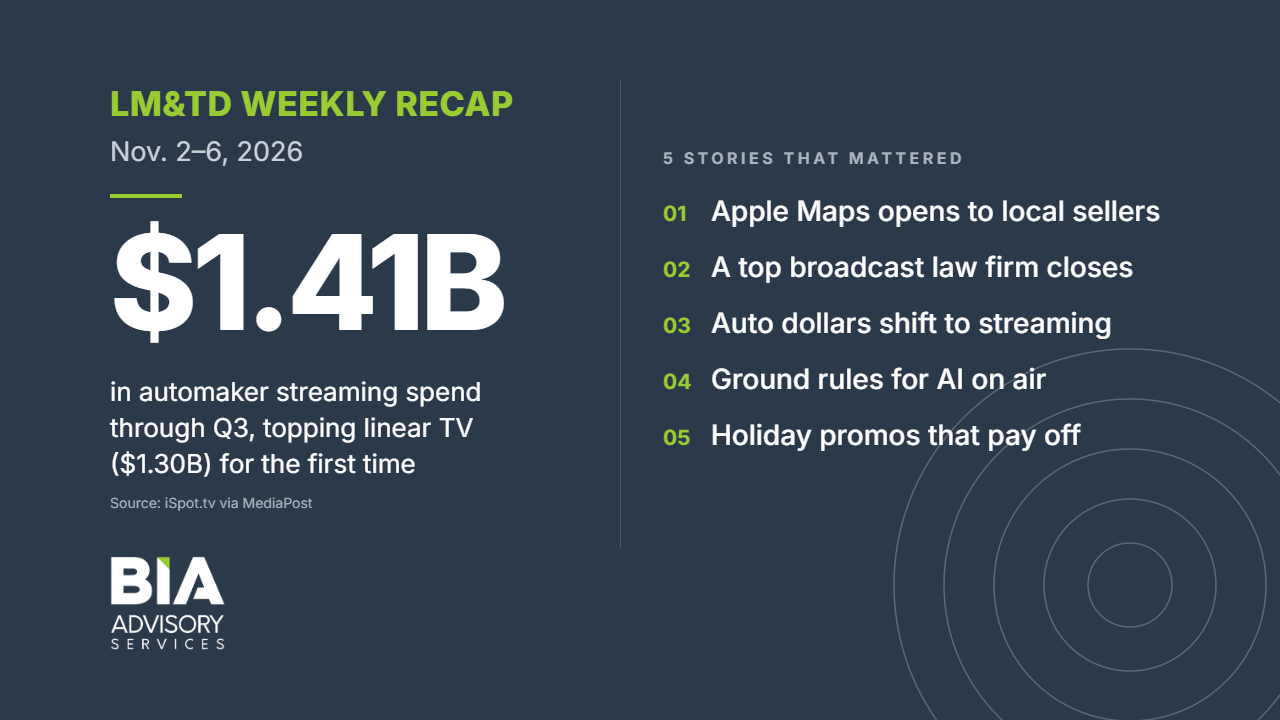
For the first time, automakers are spending more on streaming than on linear TV: $1.41 billion vs. $1.30 billion in cross-platform spend through the third quarter of 2026, according to iSpot.tv data reported by MediaPost. iSpot estimates automakers’ national linear spending fell 14.8% through August. Each of the top five brands in the quarter (Toyota, Hyundai, Ford, Chevrolet and Kia) spent more on streaming, though linear still delivered more reach for each.
iSpot’s read is that automakers are spending where people are ready to buy, and that streaming lets a single dealer target viewers the way only a national brand could before.
For local TV, the message is to pitch dealers and dealer associations on both: linear for reach and the station’s own streaming inventory for targeting, sold as one local video plan.
Setting ground rules for AI on air
At a Mentoring and Inspiring Women in Radio webinar, hosts and programmers shared how they use AI for show prep, spots and social clips without giving up the voice listeners tune in for. iHeartMedia San Francisco co-host Carolyn McArdle named her biggest early mistake as “ripping and reading.” A chatbot’s follow-up question was still sitting in an endorsement script she was reading live, and she had to abandon the copy mid-spot. Others stressed fact-checking and treating AI output as a first draft.
The guardrails are becoming legal, too. Pennsylvania’s AI ad disclosure law takes effect Dec. 21 and could require on-air disclosures when synthetic voices or other AI content give consumers a misleading impression of what is being sold. Using AI alone doesn’t trigger a disclosure. Attorneys told Inside Radio it is still unclear whether stations could be liable for spots produced by outside advertisers.
Station managers should add AI checks to copy approval now, especially for multistate campaigns, since Pennsylvania’s standard differs from New York’s and California’s.
Turning holiday promotions into revenue
The real WKRP, the Cincinnati-area station Randy Michaels and Jeff Ziesmann flipped to the famous call letters in May, is bringing what may be radio’s most famous promotion to life. On Nov. 25 in Hamilton, Ohio, up to 3,000 rubber turkeys bought in advance will launch from a fire-truck ladder, a nod to the 1978 “Turkeys Away” episode of WKRP in Cincinnati. The turkey closest to the target wins cash. Net proceeds go to a Butler County food pantry, and four local sponsors are on board.
It is a useful template: a nostalgic hook, sponsor support, a charity tie-in and online sales that let out-of-market fans take part.
Sellers also have fresh holiday ammunition. A new Katz Radio Group deck cites Nielsen studies putting radio’s average return at $17 for every $1 spent in key holiday categories, led by grocery at $23. It also notes AM/FM’s 82% share of ad-supported in-car audio time among adults, per Edison Research.
Looking ahead
The Senate Commerce Committee holds its hearing on FCC nominee Danielle Thumann Severs on Nov. 10. FEMA will run the nationwide EAS test at 2:20 p.m. ET on Nov. 17, with ETRS Form Two due by Nov. 19. WKRP’s turkeys fly Nov. 25, and Pennsylvania’s AI disclosure law takes effect Dec. 21. With political dollars receding, the groups that broaden their bundles, follow auto budgets into streaming and tighten legal and AI practices will start 2027 ahead.
Catch up on every issue in the Local Media & Tech Daily newsletter archive.
