
When looking at big spenders in local media and marketing, restaurants, retail, and home services are often the verticals at the top of the list. They’re also driven by – and subject to – unique and endemic factors. They each have different operational dynamics, challenges, and peak seasons. Knowing these variables inside and out can engender a competitive edge for local media, marketing, and commerce players.
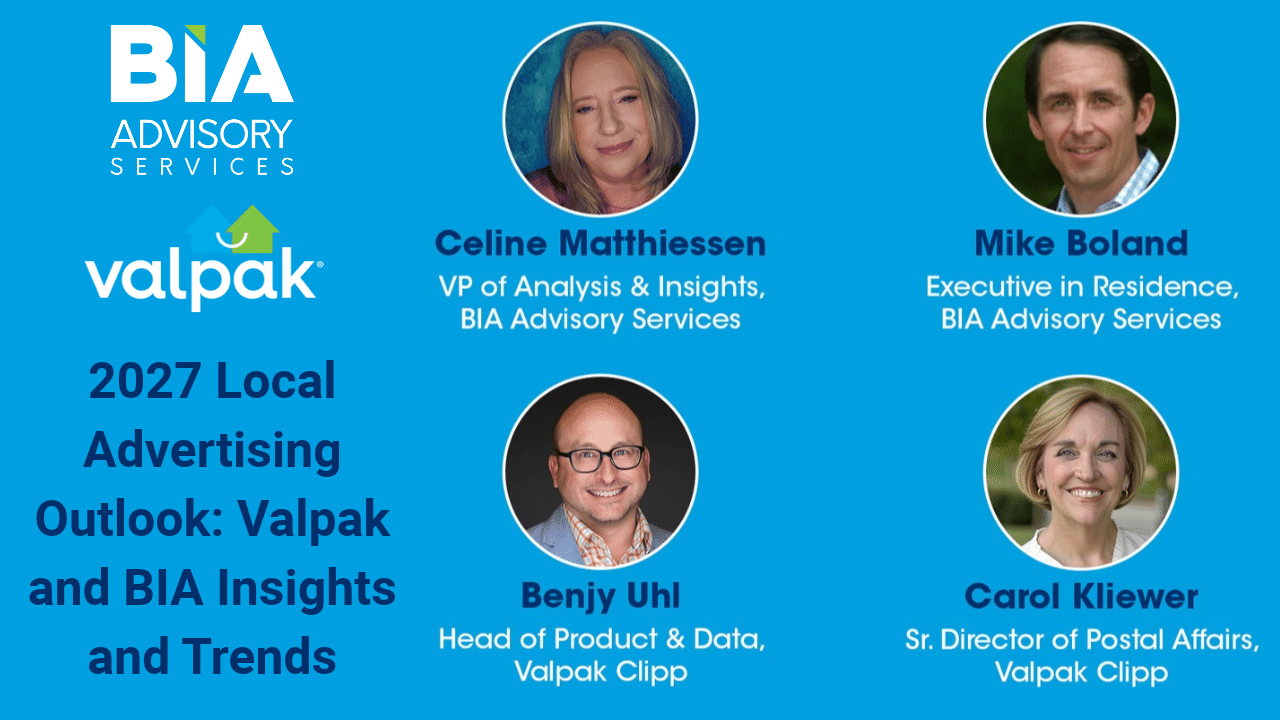
This was the topic of a recent webcast hosted by Valpak. With guest speakers from BIA, the data-driven discussion covered things like multi-channel tactics, full-funnel marketing approaches, and a crash course in emerging tech trends that impact local marketing. Read on to see our summary and presentation highlights and enjoy the quick sizzle reel below. BIA clients can also get an inside track and a deeper dive into the takeaways and our broader analysis that sits behind them.
Highlight Reel
As for takeaways, there were several – more than can be summarized here. But in the interest of offering some red meat, here are the highlights that stood out most to us.
Starting at the top, local ad budgets are heading into 2027 with direct mail as the steady hand. That was the throughline of the webinar narrative that paired BIA’s local ad forecast with a Valpak survey of home services, retail, and restaurant owners.
Start with the forecast. Mail is the second-largest local channel BIA tracks, behind only mobile. Its 2027 spend is projected at $38.2 billion, compared with $29.3 billion for local video (TV, cable and digital TV) combined. Just as notable, less than 5 percent of mail is political, versus 38 percent of CTV/OTT in 2026. Translation: when election dollars exit, mail has no hole to fill. BIA’s Celine Matthiessen said non-political demand is growing 5.5 percent from 2026 to 2027.
Mobile is the other pillar. According to BIA, it reached $45.1 billion in 2026 (up 8 percent) with less than 1 percent of spending made up of political ad dollars. It’s a mature channel acting like a younger one and that’s where things get interesting.
One-Two Punch
Google’s AI Overviews and AI Mode now show up in more than half of its results, and it just launched multi-turn advertising, which treats each conversational turn as new inventory. That answers why Google would disrupt its own 10 blue links. It also has a motive: its Q3 search ad revenue was flat, so the payoff hasn’t arrived yet. Meanwhile, ChatGPT is building its ad business ahead of an expected IPO, and Apple Maps just launched ads after 15 years.
So what’s a local business to do amid the chaos? There’s one clever hack among others: steer users toward branded search (“Smith Plumbing”) rather than unbranded (“plumber near me”). Mail is built for that. It does the upper-funnel branding, then high-intent search captures the demand. When the water heater goes out, those top-of-mind brands tend to get the worm.
That also explains mail’s credit problem. Valpak’s Benjy Uhl called it a measurement problem rather than a mail problem. Long sales cycles mean the lead arrives weeks later in the form of a branded search or phone call. In a ‘last-click attribution ‘ world, the upstream mailer often gets short-changed. The fix is tracking beyond call counts (QR scans, matchback, cost per lead and per sale) plus tested offers. Restaurants fare better thanks to coupon redemption. Retail should watch store traffic and branded search.
Fish Where the Fish Are
So what are other important dynamics among these three mega verticals? Let’s break down a few highlights for each.
Within home services, there are several categories (Think: service pros, home centers, etc.). If we break these down, the three trade categories lead with mobile (about 30 percent of spend), while six retail-oriented categories lead with mail (33 to 38.4 percent). All nine are growing 4.4 percent. In Valpak’s survey, 64 percent of owners expect the economy to improve, and better targeting (41.5 percent) beats price as the top reason to switch ad partners. In fairness, price is still the biggest obstacle, at 39.6 percent.
Retail is BIA’s top local category, growing from $26.4 billion to $27.4 billion. Owners are optimists (71 percent expect improvement) but stretched, with 62 percent citing cash flow as their top worry. They buy for awareness yet judge on sales, which is why 30.3 percent plan to grow mail versus 13.6 percent who’ll cut it.
Restaurants are the cautious ones: 35 percent call the economy positive, 27 percent negative, and 70 percent cite rising costs. Still, BIA sees spend rising from $15.6 billion to $16.3 billion, and 80 percent of owners include an incentive in their ads. Another 52.5 percent would consider shared mail.
But across all of these verticals, timing is everything. Restaurants peak in Q2 in terms of their share of annual ad spend (40 percent), while retail peaks in Q1 (30.3 percent) and home services in Q2. For sales teams, that’s an open-season calendar.
Lastly, the wild card is postage. Valpak’s Carol Kliewer is still forecasting an 8 percent marketing mail increase in July 2027, though USPS hasn’t shared cap space and won’t until at least late January. Mail is resilient, but that could test it.
Back to the throughline: knowing your customers beats spray and pray. We’ll see whether mail’s steady hand holds as AI search heats up. (Note: BIA ADVantage clients – we will load the webinar deck into the platform for download. Stay tuned for details.)
