
LM&TD Weekly Recap Oct. 26-30, 2026
By Suzanne Ackley
The LM&TD Weekly Recap is BIA’s weekly look back at the most important stories from our Local Media & Tech Daily (LM&TD) newsletter. Each post highlights the stories worth your time on the deals, data and trends shaping local broadcast, audio and digital advertising, with links to read more.
Here is what mattered most in the LM&TD newsletter for the week of Oct. 26-30:
Closing the gap between broadcast and streaming
On BIA’s Leading Local Insights Podcast, BIA Managing Director Rick Ducey talked with Locality’s Ann Hailer about making CTV and broadcast work together. Her starting point: viewers don’t care whether they’re watching broadcast or streaming, but advertisers still plan, buy and measure the two separately. With budgets tight, those advertisers want proof of what ran, who saw it and whether it worked.
The revenue gap is real. At TVNewsCheck’s Local TV Strategies conference, Viamedia’s Evan Rutchik said about half of audience time is now spent in streaming, but only about 20% of the revenue lands in local streams. His fix is to make streaming inventory addressable so programmatic buyers can reach it with the automation they already use. CBS said its streaming inventory went from heavily unsold two years ago to nearly sold out today. Scripps described “modular” stories that run on any platform without anchor intros, and Gray said its sellers already pitch packages across every screen.
For station sales teams, the takeaway is to sell one local video audience rather than separate linear and streaming line items, and to come ready with proof of performance.
Putting AI to work in newsrooms and ad sales
Two University of Texas at Austin seniors, Shreyan Daulat and Renil Gupta, built BeatNews, an AI tool that constantly scans the municipal and government sources reporters otherwise monitor by hand. Nexstar’s KXAN Austin and CBS-owned KCAL and KCBS Los Angeles are already using it. The founders said demand was stronger at TV stations than at newspapers or radio, as consolidation leaves fewer journalists covering the same ground.
AI is reaching ad sales, too. Triton Digital says it completed the first audio ad buy negotiated and booked entirely by AI agents, in minutes rather than days, within pricing and brand-safety rules the publisher set in advance. At TVNewsCheck’s Build vs. Buy panel, station group leaders said the question is no longer whether to use AI, but where to spend, which vendors to trust and what to build in house.
Correcting advertisers’ picture of radio
Advertisers estimate that radio reaches 43% of Americans weekly; Nielsen puts it at 86%. That gap leads Radio Ink’s 8 Advertiser Myths About AM/FM Meet Real Radio Data, based on a Cumulus Media/Westwood One Audio Active Group analysis. Advertisers also guessed AM/FM holds 26% of ad-supported audio time, while Edison Research’s Share of Ear puts it at 64%. And while CMOs rank radio last for perceived effectiveness, Nielsen’s benchmarks rank AM/FM fourth in U.S. ROI at $2.14.
The car remains radio’s stronghold, even in EVs. Edison’s third-quarter Share of Ear found that AM/FM and its streams account for 42% of in-car audio time among EV drivers and riders, more than any other platform, though below 53% for all Americans 13 and older. The EV figure rests on 160 respondents. It arrives as the AM Radio for Every Vehicle Act, passed by the House in September, awaits Senate action.
Tracking the deals
In the latest weekly FCC filings, TVNewsCheck’s Station Trading Roundup, based on BIA Advisory Services’ data, tallied two TV deals worth $7.38 million, both by Sinclair. It is paying $4.13 million for KOKI Tulsa from Rincon Broadcasting Group and $3.25 million for KHSV Las Vegas from Howard Stirk Holdings.
In radio, the FCC’s Audio Division dismissed an informal objection to Hoffmann Media Group’s purchase of Audacy’s six-station St. Louis cluster, including KMOX, clearing the $20 million deal. Smaller clusters keep changing hands: Pamal Broadcasting filed a $1 million deal for 10 New York stations from Galaxy Communications. BIA’s next monthly Broadcast Media Transactions report will show whether October continues September’s rise in radio station count.
Banking a record political year and planning for the reset
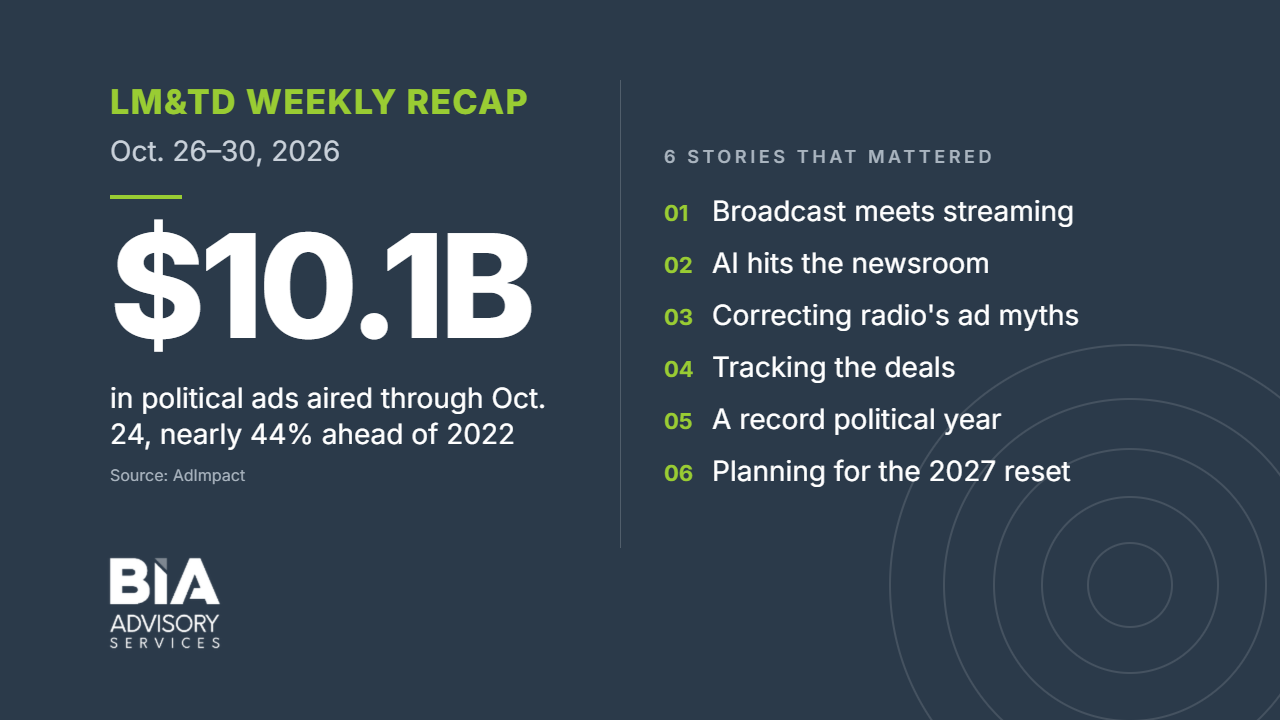
AdImpact says $10.12 billion in political advertising aired through Oct. 24, nearly 44% ahead of the same point in the 2022 midterms. What parties pay is still unsettled. The RNC, the Texas GOP and four Republican candidates sued in federal district court in Amarillo, asking the court to declare the lowest unit charge law unconstitutional to the extent it covers only candidates. They want the rate extended to parties or, as a fallback, eliminated for everyone. No ruling has been issued.
The hangover is coming. S&P Global’s Kagan forecasts TV industry revenue of $40.6 billion in 2026, falling about 6% to $38 billion in 2027 without political, World Cup and Olympics dollars, before rebounding to $41.8 billion in 2028. That makes this fall’s 2027 budgets the place to lock in which non-political categories will fill the gap.
Looking ahead
Election Day on Nov. 3 closes the record political cycle, and the 2027 reset starts right after. Radio engineers should watch an FCC proposal, now open for comment, that would allow exceptions to FM tower-spacing rules when a move causes no added interference. The groups that turn this fall’s political revenue into streaming, AI and smarter sales will be best positioned for next year.
Catch up on every issue in the Local Media & Tech Daily newsletter archive.
