Starting this week, BIA is launching the LM&TD Weekly Recap, a look back at the most important stories from our Local Media & Tech Daily (LM&TD) Newsletter. Each post will highlight the stories worth your time on the technology, deals, data, and trends shaping local broadcast, audio, and digital advertising, with links to read more. If you’re short on time, it’s a quick way to catch up on what matters most to local media sellers, owners, technologists, and advertisers.
Here is what mattered most in LM&TD newsletter for the week of Oct. 19-23:
Radio deals heat up as brokers bet on 2027
BIA’s September 2026 Broadcast Media Transactions report counted 87 commercial radio stations sold for a combined $16.98 million, led by a $7.8 million, 25-station ESOP transaction at Leighton Enterprises. TV was quiet by comparison, with two deals worth $6.85 million, including Sinclair’s $6.5 million purchase of KRNV Reno. Inside Radio noted that radio station sales have climbed for a third straight month. In the latest weekly FCC filings, TVNewsCheck’s Station Trading Roundup, based on BIA Advisory Services’ data, tallied two TV deals worth $600,000, led by Weigel Broadcasting’s purchase of WGTB Charlotte.
Ownership is shifting at the top, too. Cumulus Media completed its second Chapter 11 restructuring on Oct. 16 and emerged as a privately held company owned by its former lenders, with roughly $550 million in debt eliminated. In Radio Ink’s Be Greedy: Radio’s Top Brokers Bet on 2027, three leading brokers said radio ownership is being restructured, not disappearing, and that 2027 is the year to buy. Radio Ink’s As Consumers Cut Back, Radio Has a Value Pitch adds the sales case: in a Nielsen Media Impact simulation for a large fast-food chain, moving 10% of the media budget to radio raised reach 20% without increasing total spend.
Radio’s measurement question
The Media Rating Council revoked Nielsen PPM accreditation in four radio markets and denied it in 18 more. Baltimore, Jacksonville, Philadelphia and Pittsburgh lost accreditation, while New York, Dallas, Houston, Boston, Washington, D.C., and San Francisco were among those denied. The MRC did not give a reason, and 24 PPM markets kept their accreditation. Sellers in the affected markets should be ready for questions from buyers.
AI moves from threat to tool
William Pollack, who has spent four decades owning local radio and TV stations, argued in AI Won’t Kill Local Media; It Might Just Save It that AI should handle accounting, commercial scheduling and spotting new advertising prospects so staff can spend more time in their communities. For retail clients, Radio Ink reported YouGov data showing that 34% of likely Black Friday shoppers plan to use AI, but only 4% would let it buy without asking. That leaves room for a trusted local voice.
On the TV side, Fox expanded its agentic AI ad platform to live and linear TV. The Weather Company introduced Weather Story Assist, an AI tool that turns a single forecast into story ideas for broadcast, streaming, web and social, with nothing published until a meteorologist signs off. On BIA’s Leading Local Insights Podcast, Rick Ducey and Tracy Swedlow discussed TV’s AI Blind Spot and what broadcasters are missing.
Hurricane Isaias shows broadcast’s value
Hurricane Isaias hit the Florida Panhandle and parts of Alabama and Georgia this year. In a TVB survey of 795 people affected by the storm, 81% named local broadcast station news as their leading source of storm information, RBR reported, and 70% watched live local newscasts on a mobile device or computer at some point during the emergency. Radio Ink reported that the storm gives AM Act backers a case for car radio.
Political spending hits new highs
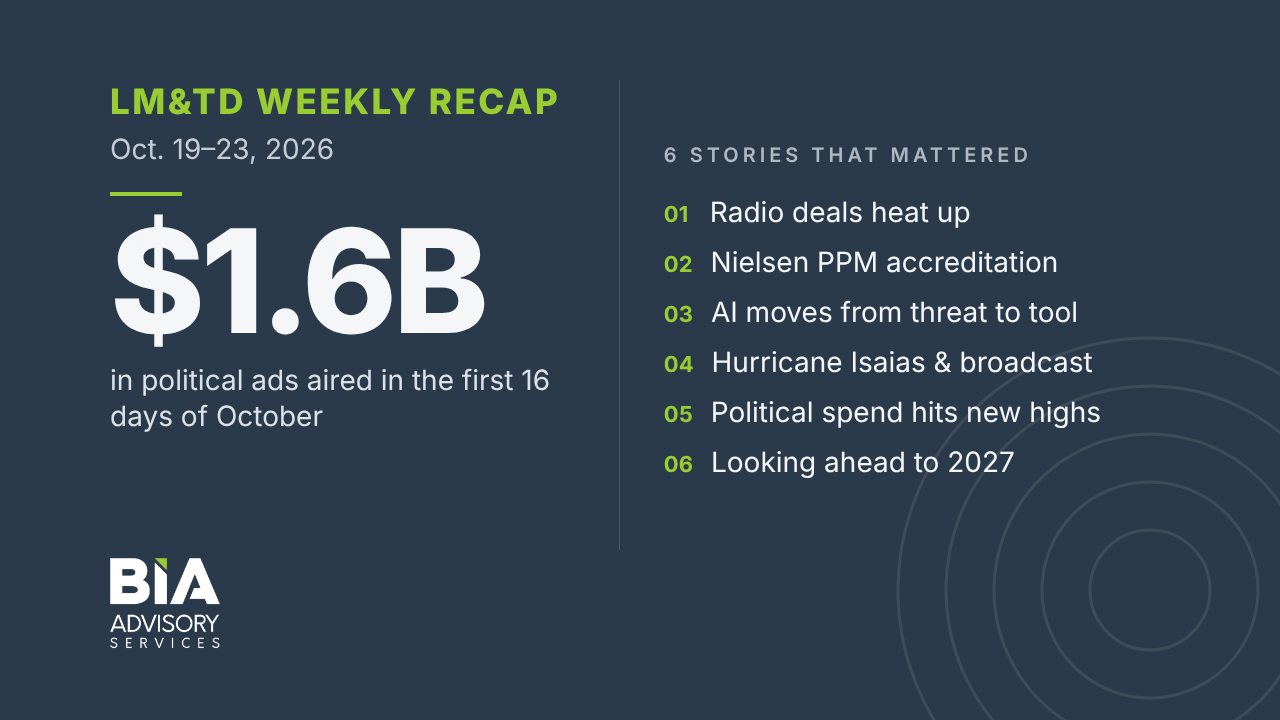
AdImpact counted $1.6 billion in political ads in the first 16 days of October, already more than September’s $1.58 billion. It projects a record $11.6 billion for the cycle, including $273 million for radio, and Inside Radio noted that local NFL rates above $400,000 in some battleground markets could push campaigns toward radio.
On rates, the Supreme Court on Oct. 14 paused a Fourth Circuit order, which keeps the FCC’s guidance extending lowest unit charge to party committees and joint fundraising committees in place through Election Day. The Court did not rule on the merits, so the legal question remains open. Broadcast CFOs from Nexstar, Sinclair and Cox Media Group expect limited impact from the expansion; Sinclair said party and coordinated spending is in the mid-single digits as a share of its political revenue.
Looking ahead
With no Olympics, World Cup or midterms next year, TVNewsCheck says local TV sees 2027 as a building year, with groups focused on ad tech automation, addressable linear and audience-based buying. Closer in, FEMA will run a national EAS test on Nov. 17 at 2:20 p.m. ET. The groups that put this fall’s political revenue into AI, digital and smarter radio sales will be best positioned for 2027.
Catch up on every issue in the Local Media & Tech Daily newsletter archive.
